


October 18, 2026
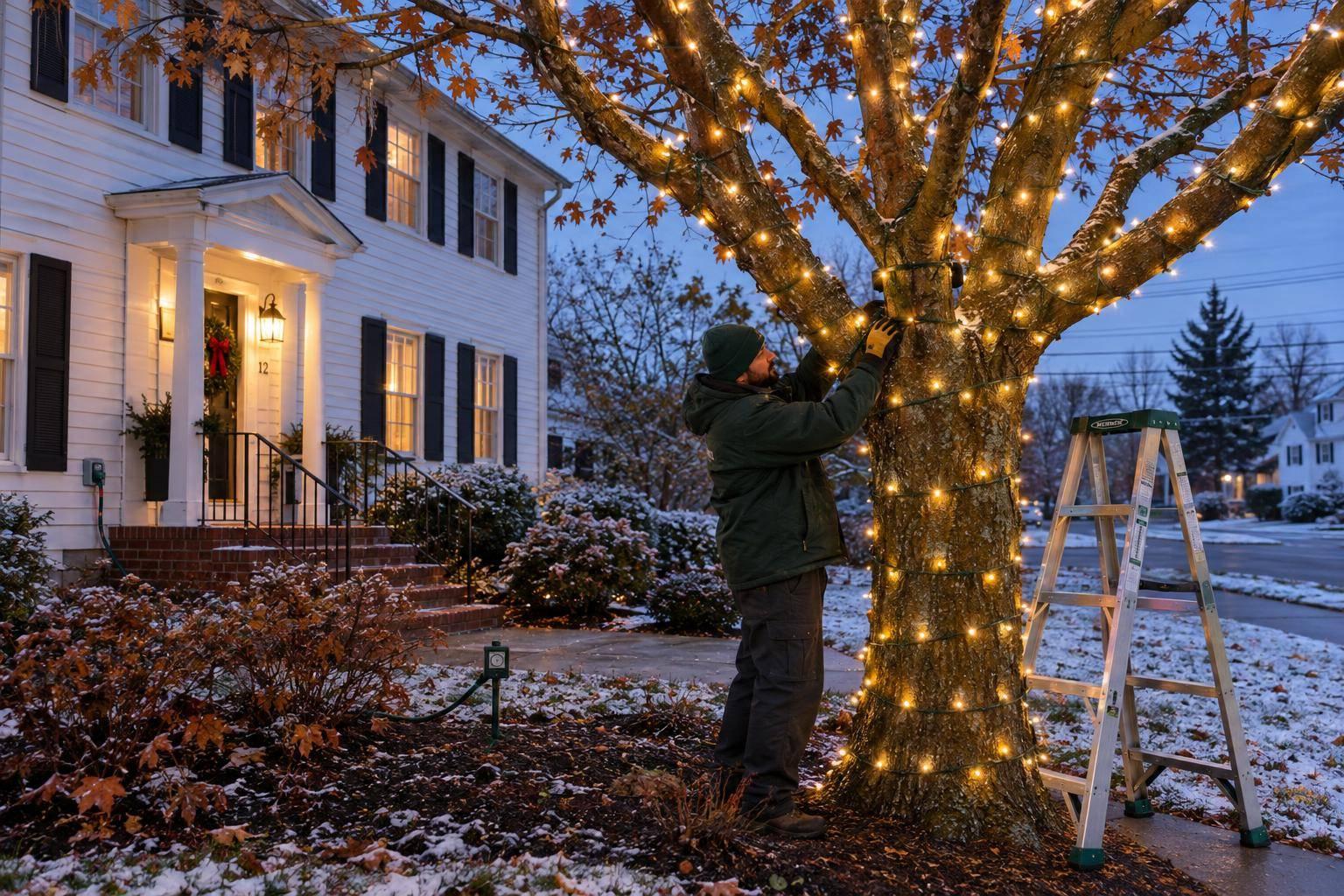
To light your North Jersey trees without damaging them, use outdoor-rated LEDs, keep strands loose, and remove them by mid-January. Check for weak or cracked limbs first, skip trees planted less than 2 years ago, and keep lights, cords, and ladders clear of power lines.
For high branches or unsafe access, hire a professional Christmas light installation service. If a tree touches a power line, contact the utility instead.

Tree-Safe Christmas Lighting in North Jersey
Work only on a warm, dry day, and skip icy conditions. Do not climb trees.
Leave newly planted trees - those established for less than two years - out of your wrapping plan. For established trees, choose branches at least 1 inch in diameter, and avoid dead, cracked, or brittle limbs. If a strand makes a branch bend, that branch cannot support the load.
Before mapping your route, check for power-line hazards. Keep ladders, lights, and cords clear of overhead and service lines. If a tree touches or grows into a line, contact the utility. Do not trim around the line or look for another way to hang lights nearby.
Once you know the tree can support the display, choose lights that fit the layout without adding heat or causing an overload. If you prefer a hands-off approach, consider the professional Christmas light installation cost for your property.
Choose UL-listed, outdoor-rated LED lights with fused plugs. Follow the manufacturer’s limits for connected strands - LED sets do not all have the same capacity.
Use GFCI-protected circuits. Keep connections off the ground and cords out of walkways and snow paths. Plan the cord route before hanging lights so your display does not create a trip hazard or interfere with winter maintenance.
With the layout set, attach the lights without squeezing the tree. Use soft ties that don’t pierce the bark - never nails, staples, screws, wire, or tight wraps.
Check each limb, lay the strand loosely, and secure it with soft cloth ties. Leave enough room for the branch to move freely without pulling the strand tight. Even soft ties can constrict a branch when tied too tightly.
Keep wires from crossing or rubbing at branch junctions. Leave slack between limbs so each can move separately. Don’t pull a strand tight to bridge a gap.
Wrap deciduous trunks in a loose spiral, extending only onto healthy main limbs. Keep spring buds on bare twigs from getting caught beneath the wire. For evergreens, drape strands lightly through the foliage so several branches share the weight.
| Tree type | Preferred lighting method | Main risk | Quick check |
|---|---|---|---|
| Deciduous trees | Loose wraps on trunks and healthy main limbs | Girdling and damaged buds | Wire has slack; buds are not caught beneath it. |
| Evergreens | Light draping through foliage | Overloaded branch tips | Several branches share the weight. |
| Large mature trees | Limit lighting to safely accessible, sound main limbs | Unsafe access and limb stress | Avoid reaching for thin outer limbs. |
Loose installation also makes season-end removal easier and safer.
Remove lights by mid-January, before bud break.
Taking down lights helps protect the tree. As it grows, even loose wires can tighten and girdle the bark, cutting off water and nutrient flow.
Choose a day when the tree is dry and temperatures are above freezing. Unplug the lights, release the ties, and carefully unwind each strand by retracing the installation path. Don’t tug strands through foliage or drag them across bark. Never remove lights from frozen branches or when temperatures are below 20°F; wait for a warmer day.
Check for bark scrapes, broken twigs, cracked limbs, wire pressure, and cord damage. Store the lights dry and loosely coiled. If wire is embedded in the bark, stop and contact a qualified arborist. Don’t dig or cut into the bark to free it.
Remove every strand at the end of the season, before spring growth begins.
If you can’t work safely with your DIY setup, stop and call a professional. That includes work involving high branches, large trees, difficult access, commercial displays, dead or cracked limbs, icy conditions, or power lines nearby.
At every step, follow the same arboriculture rule: protect living bark first. Planning around the tree’s needs helps protect its bark and branches, along with your wiring.
Need help choosing your next step?
Drawing on my arboriculture background, I tell homeowners: if you have to pull or force the wire to keep it in place, it’s probably too tight. You should be able to slide a finger easily underneath it.
Check for indentations in the bark, pinch points, or noticeable bending of branches. These are signs the wire is too tight. Use a loose spiral or drape so branches can move and grow naturally throughout the season.
Not necessarily, but lights add weight to branches and can make them more likely to break during heavy snow or ice. Drawing on my background in arboriculture, I recommend securing lights without putting extra stress on young or brittle limbs.
If a storm is forecast, check that connections are secure. Make sure the lights won’t snag or pull as branches shift under the weight of snow.
Loosen tight wraps, then use soft fabric strips or tree-friendly branch clips to hold wires loosely. Skip nails, staples, and tight wire wraps. They can damage living tissue beneath the bark and leave the tree open to pests or rot.
Based on our founder’s arboriculture background, we recommend giving branches room to move and grow. Drape lights over them instead of wrapping them tightly.

