


September 13, 2026
If you want holiday lights up by Thanksgiving or the first week of December, you should usually book in late August through early October.
For most New Jersey homes, 4–8 weeks is the right lead time. Larger homes, custom displays, and commercial properties often need 8–12 weeks or booking as early as August. After Halloween, many holiday light installers only have a few open dates left.
Here’s the short answer:
New Jersey weather can tighten install schedules fast. Rain, wind, short fall daylight, and early snow can reduce open workdays, especially in North Jersey. That is why booking early gives you a better shot at your target date, plus time to line up cleaning, installation, and January takedown.
Quick Comparison
| Property type | How far ahead to book | Best booking period | Main reason |
|---|---|---|---|
| Townhome / simple layout | 4–6 weeks | September to early October | Fills into peak season |
| Standard single-family home | 6–8 weeks | Late August to September | Better date choice |
| Large home / steep roofline / custom display | 8–12 weeks | August to September | More labor and materials |
| Commercial / HOA / multi-unit | 8+ weeks | August to early September | Access and scheduling details |
If your home also needs house washing, roof cleaning, or gutter cleaning, those jobs should be scheduled first so the lighting crew can install on clean, clear surfaces.
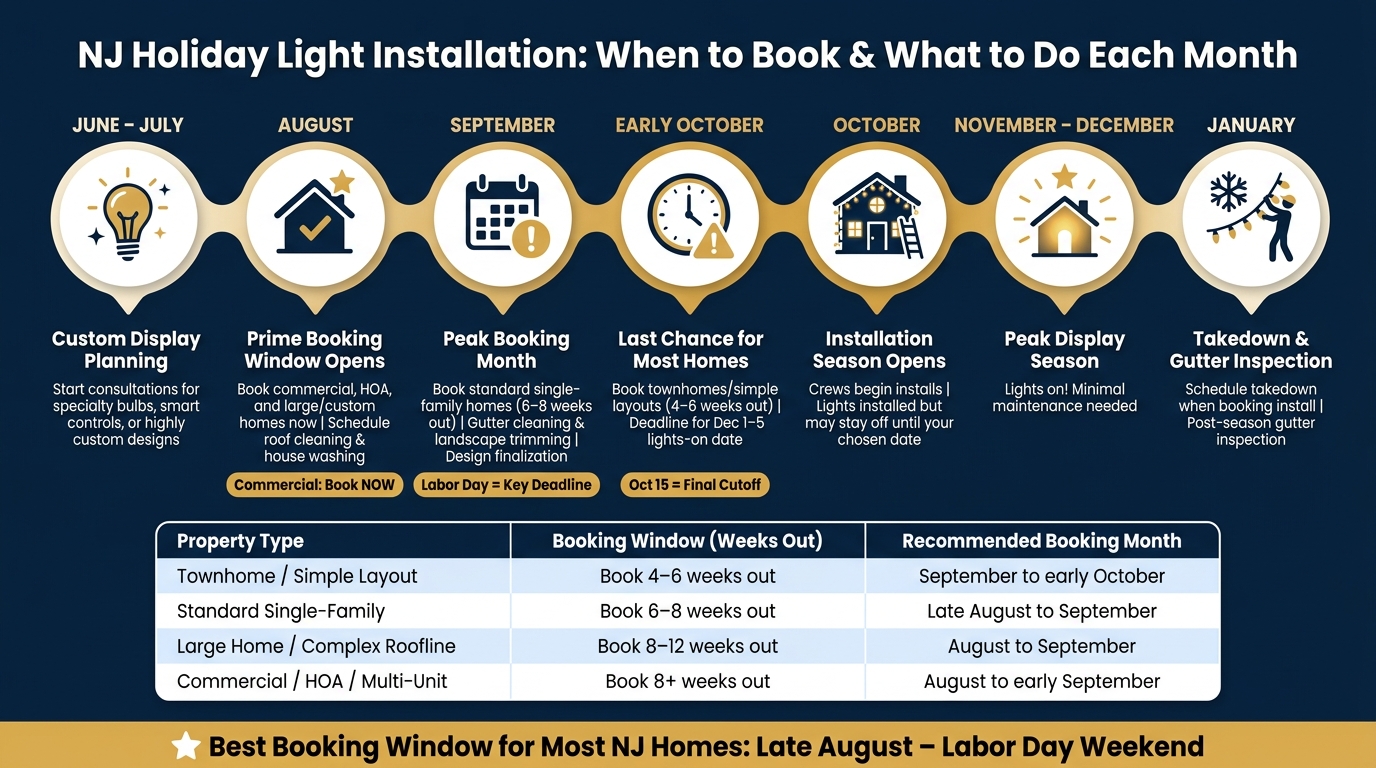
NJ Holiday Light Installation: Month-by-Month Booking & Prep Timeline
Booking lead time changes with the property. A simple townhome is one thing. A large home with steep peaks, custom lighting, or business access issues is a whole different ballgame.
The main factors are size, layout, and job logistics. Start with the simplest property type, then adjust based on roofline complexity and scheduling needs.
For most standard single-family homes in New Jersey, book 6–8 weeks in advance. Townhomes and simpler layouts usually need at least 4–6 weeks.
That timing matters because crews fill up fast once the season gets busy. If you want a better shot at your preferred date, aim to book by Labor Day weekend.
Once a property gets bigger or the design gets more detailed, the timeline stretches. Large homes, homes with multiple roof peaks, and custom displays should be booked at least 8 weeks ahead. If the design is highly detailed, plan for 10–12 weeks.
Why the extra time? These installs take longer crew blocks, and custom work may call for special materials, especially for coastal or custom installs. For shore properties, it makes sense to target mid-October for installation so everything is secured before nor'easters start becoming a concern.
Commercial buildings, HOAs, and multi-unit properties need the most lead time. There’s usually more to sort out, like parking access, tenant notices, and coordinating around business hours.
For these jobs, the right booking window is August through early September.
Use the summary below to match your property type with the right booking window.
| Property Type | Recommended Booking Window | Key Factor |
|---|---|---|
| Townhome / Simple Layout | 4–6 weeks out | Books into peak-season calendar |
| Standard Single-Family | 6–8 weeks out | Book by Labor Day |
| Large Home / Complex Roofline | 8–12 weeks out | Labor time and material sourcing |
| Commercial / HOA / Multi-Unit | August – Early September | Access, notifications, and coordination |
Next, factor in roofline complexity, custom work, weather, and access before you lock the date.
Your booking window depends on the property itself. A small, simple home with easy power access can fit into a tighter schedule. A large house with steep rooflines, custom lighting, and tricky weather conditions usually needs more runway.
That’s why the same timeline can work for one New Jersey home and fall short for another.
Bigger homes usually take more time. Properties over 3,000 sq. ft. often need 10–14 hours of installation labor, while smaller homes tend to land closer to 4–6 hours.
Roof shape matters too. If the home has multiple peaks, steep slopes, or detailed architectural features, installation time and price can climb by 10% to 30%. It’s a bit like hanging lights on a plain frame versus wrapping them around a maze.
Power access can also slow things down. If the nearest outdoor outlet sits more than 50 feet from the display, the crew may need extra wiring or trenching. That can add $300 to $1,200 to the job. One small step helps here: test your GFCI outlets early to avoid last-minute issues.
If the layout is simple, the calendar tends to be the main factor. If the design is custom, the planning clock starts much sooner.
Custom displays take more than an install day. There’s usually a consultation, site visit, measurements, and mockups before materials get ordered. If you want specialty bulbs or smart controls, start in June or July.
Weather in New Jersey can tighten the schedule fast. Coastal winds, early nor'easters, and freezing temperatures can shrink the safe install window, which is why earlier booking gives you more room to work around good conditions.
It also helps to lock in your January takedown when you book the install. Those spots fill fast.
Once you know your lead time, count back from the date you want the lights turned on.
Once you know your lead time, turn that into a firm booking deadline.
Choose the date you want your lights to turn on, then count back 4–8 weeks to set your booking deadline. That gives you a clear window for getting a quote and locking in your install.
In New Jersey, many installers ask for a deposit to reserve your date. A lot of crews also handle installs in October, then leave the lights off until your chosen start date. That setup can help if you want to beat the rush without switching everything on too early.
A little prep can make the quote process much smoother. Have these details ready before you reach out:
These details also help crews sort out things like cleaning, power access, and takedown before the job starts.
Use this table to line up your target date with the booking window that makes the most sense.
| Desired "Lights-On" Date | Recommended Booking Window | Typical Installation Timing |
|---|---|---|
| November 1–7 (Early Season) | June – August | Early to Mid-October |
| Thanksgiving (Nov. 26) | Late August – September | Late October – Early November |
| December 1–5 | September – Early October | Mid- to Late November |
| December 10 or later | By October 15 | Early December (limited availability) |
If your property needs exterior cleaning before the install, schedule that first.
Holiday light installs hit the same fall schedule as exterior cleaning and takedown. So once you lock in your install date, put cleaning and takedown on the same calendar too. It keeps the whole job moving in the right order and helps you avoid a last-minute scramble.
Clean surfaces give clips a better hold and help light lines look straight. Professional installers use custom-fit clips that attach to gutters and shingles, and dirt or buildup on those surfaces can get in the way of a secure fit and neat lines. Cleaning first cuts down on rework and helps protect the display.
For most NJ properties, house washing and roof cleaning are best done in August, while the weather is still mild and before the busy booking stretch starts in September. Gutter cleaning should come next in early September, so installers have clear gutters and roof edges to work with when they arrive in October. On commercial jobs, crews also need clear ground access, which means exterior cleaning needs to be done before the installation team shows up.
Use the schedule below to line up each service without squeezing the install window.
Here’s a simple five-month plan:
| Month | Exterior Task | Lighting Phase |
|---|---|---|
| August | Roof cleaning & house washing | Planning & early booking |
| September | Gutter cleaning & landscape trimming | Prime booking & design finalization |
| October | Installation | Installation season opens |
| November–December | Minimal maintenance | Peak display season |
| January | Gutter inspection | Takedown and storage |
That January step is easy to overlook, but it matters. A post-season gutter inspection helps clear debris before winter weather adds more.
For most NJ homes, the best time to book holiday light installation is late August through September, with Labor Day as a good target. That window gives you time to finish the design, handle exterior cleaning, and get on the calendar before installation season starts in October. Crews like Gutter Boys fill their fall calendar in that same window, which is part of why booking early matters as much as the design itself.
If you have a custom display, a tricky roofline, or a commercial property, book earlier. Those jobs usually need more design work and more calendar coordination.
Think of cleaning, installation, maintenance, and takedown as one plan, not three separate calls. Booking cleaning and installation together is the easiest way to secure your fall schedule.
If you book after Halloween, you’ll probably run into limited availability because many of the best installation dates are already gone.
You might still get your lights installed before Christmas, but maybe not on the date you wanted. Last-minute service can also cost more, and the spots that are left usually go on a first-come, first-served basis.
Yes. You can have your lights installed in October and switch them on later.
Many professional crews start in October because the weather is usually milder, which makes installation easier and more comfortable. That means your display can be set up and ready to go well before the holiday rush.
And the best part? You stay in control of when the lights actually turn on for the holiday season.
Yes. Book your takedown when you schedule the installation. In New Jersey, many professional holiday lighting services include removal as part of a full-service package, and takedown is usually scheduled throughout January.
It also helps to talk through your preferred removal timing upfront. Scheduling often depends on crew routes, weather, and how complex your display is. Bundling both services makes the whole process easier.

.png)