


August 19, 2026
The safest pick is usually not the cheapest one. If I were hiring a Christmas light installer in North Jersey, I’d check four things first: project scope, insurance, product quality, and contract terms.
Here’s the short version:
In North Jersey, weather and roof conditions can turn a simple install into a liability issue fast. Many homes land around $1,400 to $2,800, smaller jobs can start near $899, and some companies set a $1,000 minimum. That means a low quote can leave out labor, service calls, takedown, or storage.
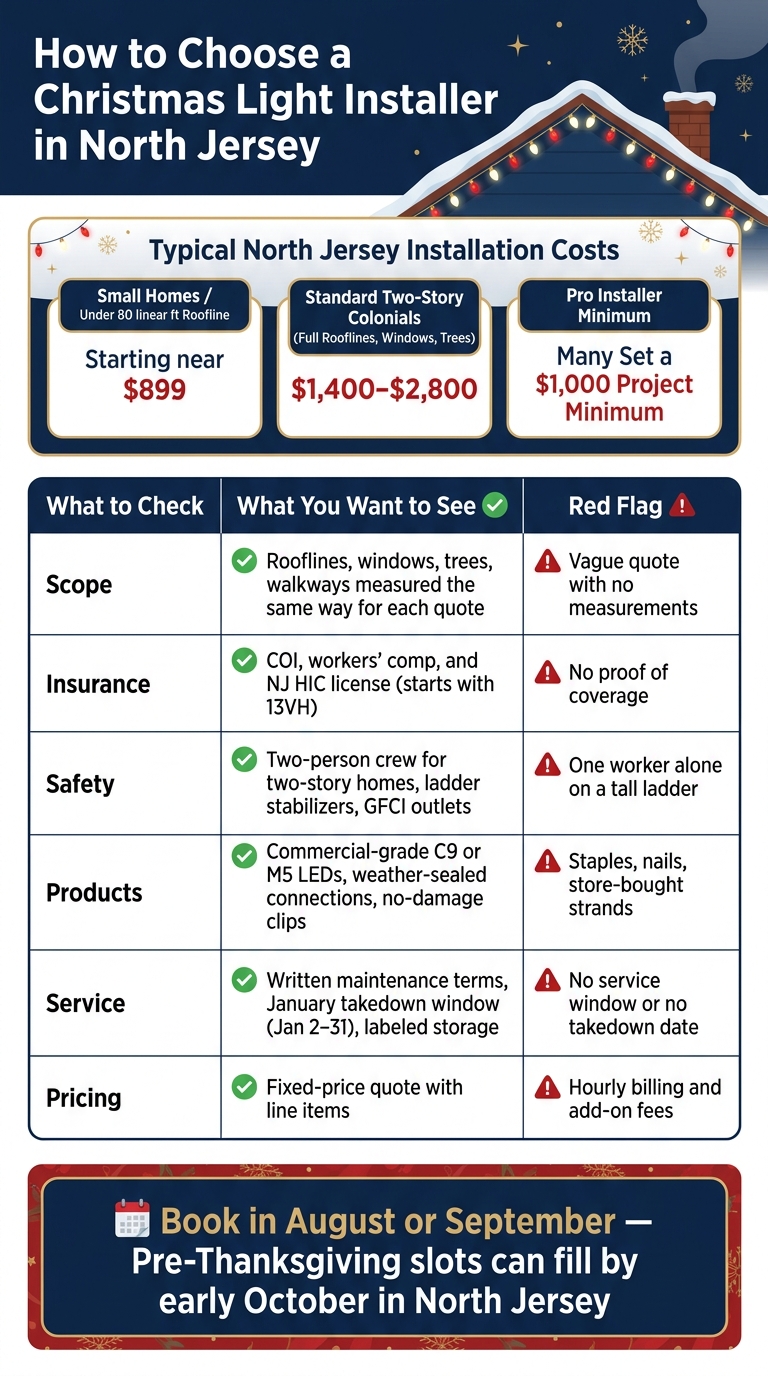
How to Choose a Christmas Light Installer in North Jersey: Key Checks at a Glance
| What I’d Check | What I’d Want to See | Red Flag |
|---|---|---|
| Scope | Rooflines, windows, trees, walkways measured the same way for each quote | Vague quote with no measurements |
| Insurance | COI, workers’ comp, and NJ HIC number | No proof of coverage |
| Safety | Two-person crew for two-story homes, ladder stabilizers, GFCI outlets | One worker alone on a tall ladder |
| Products | Commercial-grade C9 or M5 LEDs, weather-sealed connections, no-damage clips | Staples, nails, store-bought strands |
| Service | Written maintenance terms, January takedown, labeled storage | No service window or no takedown date |
| Pricing | Fixed-price quote with line items | Hourly billing and add-on fees |
If I keep those checks in place, I have a much better shot at getting a clean install, fewer mid-season problems, and no surprises after the holidays.
Before you ask for quotes, write down exactly what you want lit. Be specific. List every area: rooflines, gutters, fascia, peaks, gables, dormers, chimneys, windows, railings, entryways, walkways, and any trees or shrubs you want wrapped.
Start with measurements. That way, every installer is quoting the same job instead of guessing at a different scope.
Walk around your property and note the number of stories and the rough linear footage along your rooflines and gutters. Count trees and shrubs separately, since large trees are priced differently than shrubs.
Also note anything that could make the install harder, like:
Give each installer the same measurements and details. That keeps the quotes lined up and makes surprise add-ons less likely.
Most North Jersey homes fall around $1,400 to $2,800, while larger properties cost more.
For North Jersey winters, commercial-grade C9 LED bulbs for rooflines and M5 LED strands for trees and shrubs are the standard. They’re rated for 50,000 hours and can last 10 or more seasons.
The bulbs are only part of the job. Weatherproof connections matter just as much, and so do the mounting clips. A good installer uses clips that match the mounting surface and never uses staples or nails.
If your house needs washing or your gutters need cleaning, handle that before the lights go up.
Gutter cleaning, roof washing, and house washing should happen before installation, not after. Clean gutters, roof, and siding let the crew install once instead of removing and resetting lights later.
With the project scope set, the next filter is insurance and roofline safety.
Check insurance and safety before you line up quotes.
Ask for a current Certificate of Insurance, workers' compensation, and the contractor's NJ HIC license number before you book anything. The legal business name on the COI should match the name on the quote and contract. If it doesn't, the coverage for the company you're hiring may not apply.
NJ also requires proof of insurance to keep an HIC license active, and that license number starts with 13VH. That's a simple way to double-check what you're being told.
Workers' comp matters for a plain reason: if someone on the crew falls on your property and the contractor doesn't have it, those medical bills can end up with you. Before any work starts, confirm that both general liability and workers' comp are current and on file. For general liability, look for $1 million to $2 million in coverage.
Ask how they handle work at height. For two-story homes, require a two-person crew with ladder stabilizers. No one should be working solo on a tall extension ladder. On steep roofs, seasoned installers often work from ladders instead of walking the roof itself.
For electrical work, check for:
These aren't add-ons. They help prevent mid-season outages and fire risks.
If an installer can't show a COI, sends one worker onto a two-story roof alone, or plans to mount lights with staples or nails, cross them off.
Once the safety side looks good, move on to the products and the full-season service terms.
Once the safety checks are done, look at two things: the lights and hardware going on your home and the service you get for the rest of the season.
Ask for commercial-grade C9 or M5 LEDs that fit your roofline. Those bulbs tend to give a cleaner, more polished look than mismatched strands. You also want no-damage clips that match each surface on your home. Custom-cut strands help keep the lines neat and cut down on visible cord runs.
For mounting, the details matter more than many homeowners think. The installer should use surface-specific no-damage clips, such as:
That’s a much better setup than staples or nails, which can mark up the house and create trouble later.
A good quote covers more than install day. It should spell out what happens when a bulb goes out, a timer stops working, or bad weather knocks something loose.
Look for wording like "unlimited maintenance" or "season-long service calls" that covers bulb burnouts, weather damage, and timer resets. Also ask for a written response window for service calls. If something fails a week before Christmas, you don’t want vague promises.
Takedown should be set for a specific January window. January 2–31 is standard. Make sure the takedown date is written into the contract, not left open-ended.
For storage, check whether the installer offers labeled off-site storage. That small detail can save a lot of hassle. Your strands stay sorted, protected, and ready for re-installation next season.
This is where pricing often splits. The main difference usually isn’t just the lights. It’s how much help you get after the install.
Install-only works best for homeowners who already own lights and are fine handling repairs and storage themselves. Full-season service costs more upfront, but it usually includes materials, maintenance, takedown, and storage. Ask for a fixed-price quote, not hourly billing. That makes the total easier to compare and helps you avoid surprise charges later.
Once you know what's inside each package, put the quotes side by side and compare the final numbers. But here's the key: only compare bids when every installer is pricing the exact same scope. Otherwise, you're not comparing apples to apples.
Ask for separate line items for:
That makes it much easier to see what you're paying for. More importantly, it shows whether the numbers reflect the same work, not just the same total.
In North Jersey, pricing changes based on home size and how tricky the install is. Starter packages for small ranches or capes with under 80 linear feet of roofline usually start around $899. Standard two-story colonials with full rooflines, windows, and a few trees often land in the $1,400 to $2,800 range. Many pro installers also set a $1,000 project minimum.
Stick with fixed-price quotes so each bid stays easy to compare. Hourly billing can open the door to overtime fees and extra fuel charges you didn't plan for.
Book in August or September. In North Jersey, the best pre-Thanksgiving install dates go fast.
Once you choose a company, get those dates and services written into the agreement. Since North Jersey weather can turn on a dime, a solid installer will usually give you a date range instead of one locked-in day. That matters. A Nor'easter can show up with little warning and delay an install by several days. If a contractor promises one exact date with no backup plan, that's something to flag.
After pricing is settled, use the contract to lock in the same scope, dates, and service terms you've already discussed. Read the agreement before paying a deposit, and double-check the scope, install dates, maintenance, takedown, and storage terms.
For maintenance, look for a guaranteed response window. 24 to 48 hours is the standard among reputable North Jersey installers. Also make sure the January takedown window appears in writing. Written takedown dates can also help you stay in line with local display limits.
A few contract red flags should make you stop and look closer:
Any one of those is a reason to slow down before signing.
After looking at scope, safety, and service terms, go with the installer that's simplest to verify and easiest to deal with. The cheapest option usually isn't the best one. Pick a company like Gutter Boys, which offers professional Christmas light installation backed by a current COI and workers' comp, can explain safe, no-damage mounting, and puts everything in a clear written contract.
Here's the best order for making the call: define your scope, verify insurance, check product quality, then compare pricing. A low bid can look good at first glance, but it often leaves out service items you'll end up paying for later.
Insurance matters for a simple reason: roof work can leave homeowners exposed to liability if the crew isn't properly covered.
Once the contract is clear, get the house ready so installation day goes more smoothly. Have the gutters and fascia cleaned before install so clips seat properly and the lights stay secure. Clean the exterior, choose the safest contract, and you'll set yourself up for a smoother season.
Yes. Check it yourself and ask for paperwork, not just a verbal “yes.”
An installer should be able to show proof of insurance, including general liability and workers’ compensation. If they can’t, that’s a red flag.
This matters most when the job involves work at height. If something goes wrong and the crew isn’t covered, the cost and legal risk can land on you.
A reasonable deposit for holiday light installation is usually 5% to 10% of the total job cost. That deposit usually locks in your installation date and helps cover scheduling or any upfront materials.
For example, if a full roofline package costs $1,400 to $2,800, a 5% to 10% deposit would come out to about $70 to $280.
Usually, no permit is needed for residential Christmas lights when you’re using existing outdoor outlets. Seasonal, non-commercial displays are often exempt from local sign and zoning rules.
That said, a permit may come into play if the setup includes new hardwired exterior receptacles, low-voltage transformers, or permanent hardwired controllers. If you want to stay permit-exempt, keep the display seasonal, non-commercial, and off public property.

.png)