


September 2, 2026
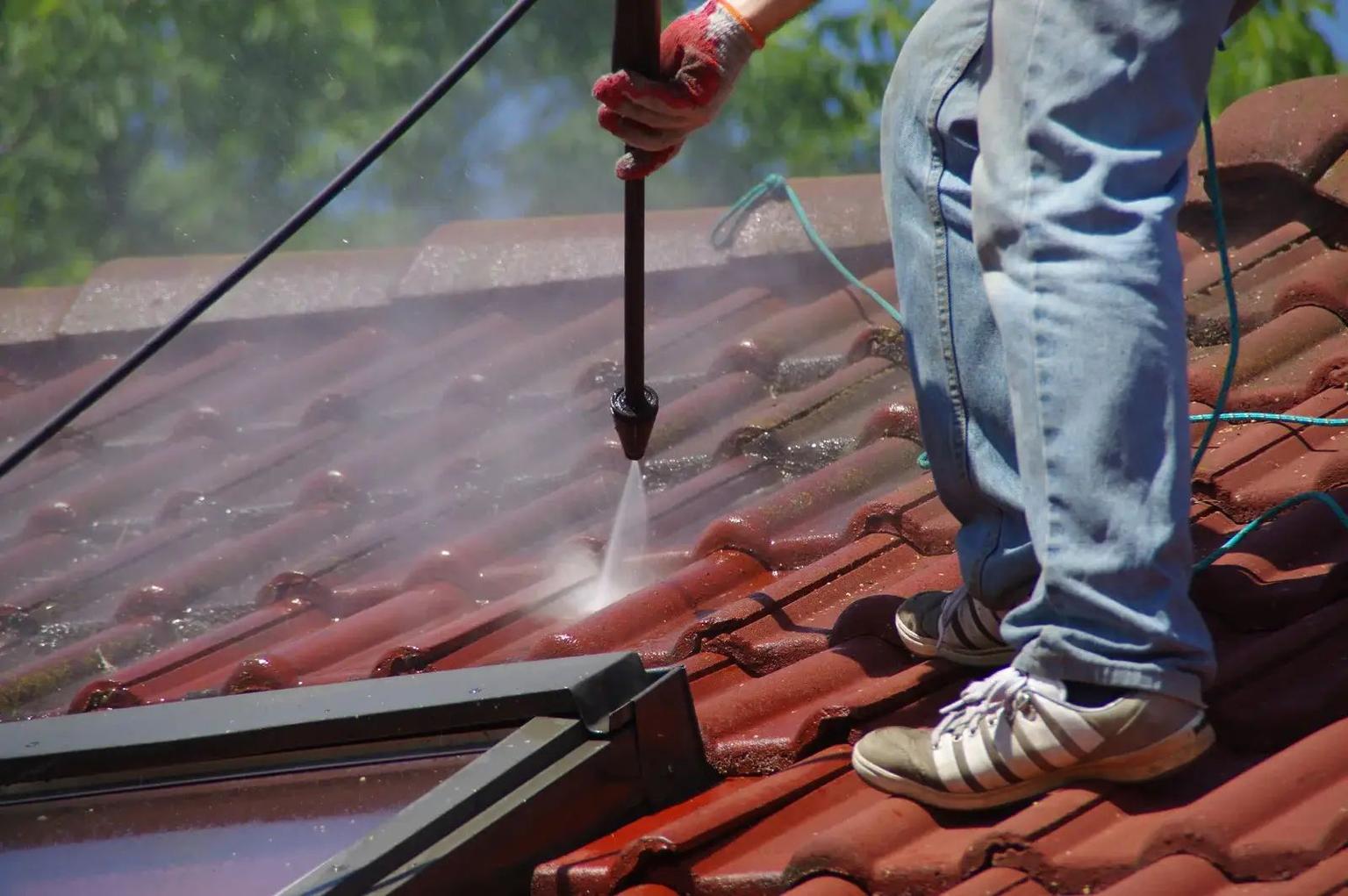
If your roof has black streaks, moss, or lichen, it likely needs pressure washing vs. soft washing.
For most homeowners, the short answer is simple: roof cleaning removes algae and plant growth, helps shingles last longer, usually stays clean for 1 to 3 years, and often costs about $300 to $750 depending on roof size and access. If shingles are curling, cracked, missing, or losing granules, cleaning is not the next step - a roofer is.
Here’s the article in plain terms:
| Question | Short Answer |
|---|---|
| What does roof cleaning remove? | Algae, moss, lichen, mold, and debris |
| When should a roof be cleaned? | When shingles are sound but stained or covered with growth |
| Is it safe for shingles? | Yes, if done with low pressure |
| How long does it last? | Usually 1 to 3 years, sometimes more or less |
| What does it cost? | About $300 to $750 for many homes |
The rest of the article breaks down each of these five questions so you can tell whether your roof needs cleaning or repair.
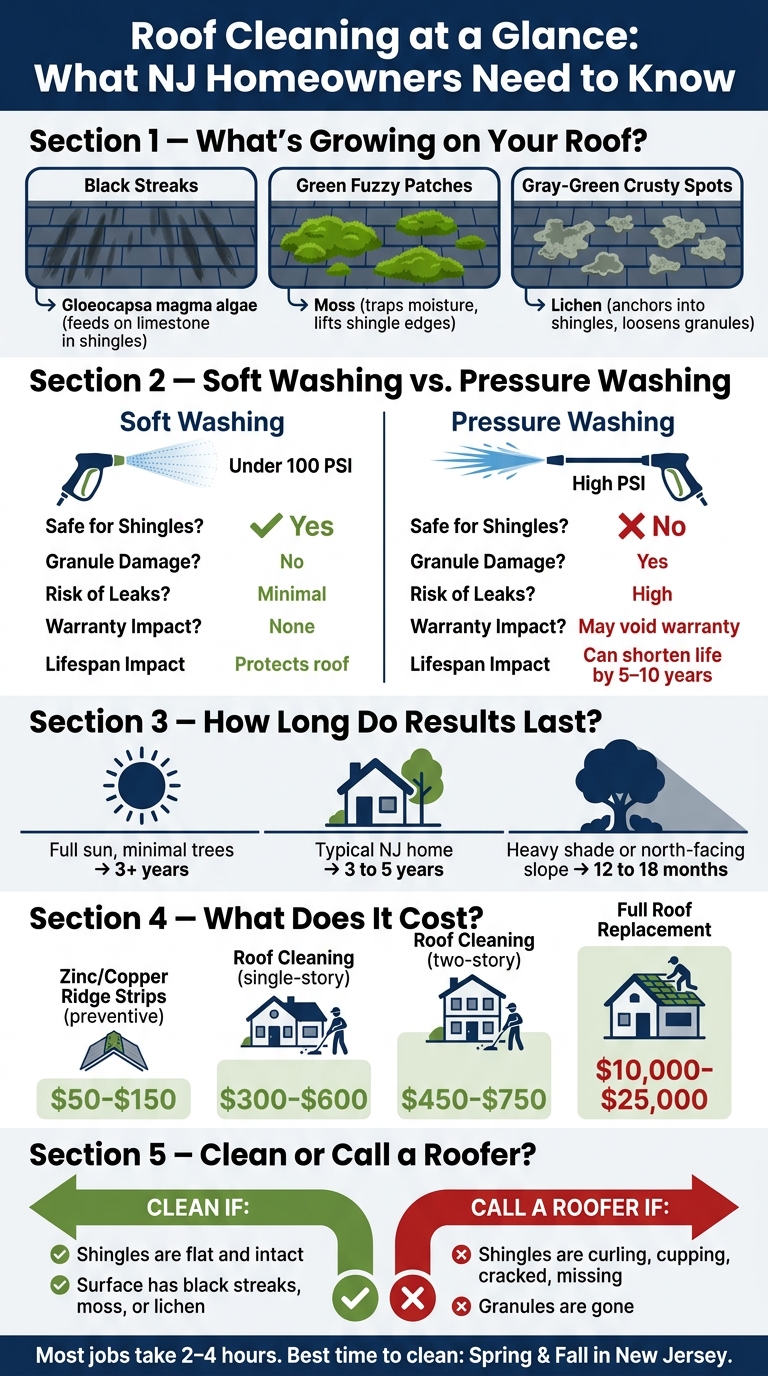
Roof Cleaning vs. Pressure Washing vs. Replacement: Cost & Impact Guide
Roof cleaning removes the growth behind black streaks, moss, and lichen on shingles. That helps slow wear and improve curb appeal. On asphalt shingle roofs, the usual method is soft washing vs. pressure washing. That means applying a low-pressure chemical solution to kill the growth at the root without harming the shingles.
Those dark lines running down your shingles usually aren't dirt or soot. In most cases, they're caused by Gloeocapsa magma, a bacteria that feeds on the limestone in asphalt shingles. As it spreads with rainwater, it leaves behind a dark coating.
Moss tends to grow in shady, damp areas and holds moisture against the roof surface. That's where trouble starts. Moisture that sits too long can speed up roof wear, lift shingle edges, and give water a way in.
Lichen is tougher to deal with. It's a slow-growing mix of algae and fungus that anchors into the shingle with root-like structures. As it sticks and spreads, it can loosen protective mineral granules and open paths for water intrusion. Unlike algae, lichen often needs a slow chemical release to loosen its grip without causing harm.
On shaded North Jersey roofs, surfaces stay damp longer. That makes it important to know when a roof just needs cleaning - and when it may need repair instead.
Most homeowners don’t think much about their roof until the signs get hard to miss: black streaks, moss, or even a leak. At that point, the big question is pretty simple - does the roof just need cleaning, or is it time to call a roofer?
Start with a ground-level check. You do not need to climb onto the roof to spot early warning signs. A pair of binoculars can make things a lot easier.
Look for:
It also helps to check your gutters. If you see granules piling up in the troughs, that can be a sign of shingle wear. And that may mean the roof is getting close to the end of its useful life.
Here’s the basic rule: clean the roof if the shingles are still in good shape and the main problem is surface staining. If the shingles look damaged, skip the cleaning and call a roofer.
If the shingles still look sound, timing matters too. In New Jersey, spring and fall are the best times to clean a roof. Roofs that stay shaded may need cleaning every 1 to 2 years.
Yes - if it's done with low pressure. High-pressure washing can damage asphalt shingles, and that's where people get into trouble.
Asphalt shingles have tiny mineral granules on the surface. Those granules help protect the roof from UV rays and help water run off the way it should. When someone blasts the roof with high pressure, those granules can get knocked loose.
Once that happens, the shingles wear out faster and don't shed water as well. In some cases, high-pressure washing can shorten a roof's lifespan by 5 to 10 years.
There's another problem too. Strong water pressure can push water up under the shingle tabs, which can lead to leaks and damage to the roof deck. That's why major shingle makers like GAF, CertainTeed, and Owens Corning recommend low-pressure cleaning methods. Using high pressure can also void a shingle warranty.
The safer option is soft washing. It uses low-pressure equipment - usually under 100 PSI, about the same as a garden hose - along with a cleaning mix that often includes sodium hypochlorite and a surfactant. This method kills algae, moss, and lichen without stripping away shingle granules.
A good crew doesn't just clean the roof and call it a day. Before applying any solution, they should:
It's also smart to check gutter flow during the job so runoff doesn't pool where it shouldn't.
Do not use a pressure washer on asphalt shingles.
How long that clean look lasts comes down to a few simple factors: the roof's age, how much shade it gets, and whether nearby trees keep dropping debris and holding moisture on the surface.
Most professionally soft-washed asphalt shingle roofs stay clean for about 1 to 3 years. If the roof sits under heavy shade or a lot of tree cover, that window is often shorter. And when shade, trees, or clogged gutters keep moisture on the roof, stains and growth tend to come back much sooner.
Moisture is the main issue here. North-facing roof slopes, nearby trees, and built-up debris keep shingles damp for longer stretches, which lets algae return faster. Clogged gutters make things worse by keeping the roof edge wet, and that speeds regrowth too.
A few basic upkeep habits can help the roof stay cleaner for longer.
These metal strips usually cost about $50 to $150 in materials and can help stretch the time between cleanings.
These conditions affect how long the roof stays clean.
| Condition | Typical Regrowth Timeline |
|---|---|
| Full sun, minimal trees | 3+ years |
| Typical New Jersey homes | 3 to 5 years |
| Heavy shade or north-facing slope | 12 to 18 months |
Roof cleaning usually costs a lot less than replacement, but the final price depends on a few things: roof size, pitch, access, and how much algae, moss, or lichen has built up. For a standard single-story home, the cost is usually $300 to $600. For a two-story home, it’s often $450 to $750, depending on the details. Put next to a full roof replacement at $10,000 to $25,000, cleaning is a much smaller hit to the budget. And yes, the same things that make growth come back faster can also make the job take longer and cost more.
Homes in New Jersey come in all shapes and setups, so the best pricing usually comes from an on-site estimate. Steeper roofs, hard-to-reach areas, and thick moss or lichen tend to push the price up.
| Factor | Effect on Price |
|---|---|
| Two-story access | Higher - requires more equipment and safety rigging |
| Steep pitch | Higher - harnesses and anchoring add labor time |
| Heavy moss or lichen | Higher - needs more solution and longer dwell time, and may require multiple applications |
| Tight lot or complex landscaping | Higher - extra time for plant protection and runoff management |
| Standard single-story asphalt roof | Baseline - typically $300–$600 |
If your roof has thick moss or crusty lichen instead of simple black algae streaks, the price will usually reflect that. That kind of growth takes more cleaning solution and may need more than one application.
Once the scope is clear, the process is pretty straightforward. A technician starts with a site inspection to check the roof material, figure out what kind of growth is present, and note any damage already there. After that, you get a written proposal before any work starts.
On service day, the crew begins by pre-wetting and protecting nearby landscaping. Then they apply a low-pressure soft wash solution and let it sit long enough to kill the growth. After that, the roof is rinsed, gutters are flushed, and the crew checks for any missed spots. Most standard jobs are finished in 2 to 4 hours.
We’ve covered what roof cleaning is, when you need it, how it’s done, and what it may cost. The main point is pretty simple: black streaks, moss, and lichen can cut a roof’s lifespan short.
For asphalt shingles, soft washing is the safe option. It cleans the roof without stripping granules or pushing water under the shingles. That matters more than most homeowners think. A roof can look dirty long before it looks damaged.
If your roof is still in good shape but covered in stains, cleaning is the right next step. Inspect it early, clean it gently, and deal with the problem before damage spreads.
Gutter Boys offers free roof cleaning estimates across Morris, Sussex, Warren, Hunterdon, and Somerset counties.

.png)